

Previous Research
Monitoring and Management of Burrowing Owls at
Naval Air Station Lemoore
Western burrowing owls (Athene cunicularia hypugaea) are declining or have disappeared from many portions of their historic breeding range. The decline of burrowing owl populations is often attributed to conversion of native grasslands to agriculture and urban development, and to declines in abundance of burrowing mammals that the owls rely on for creation of nest burrows. Naval Air Station Lemoore (NASL) is a DoD installation in central California that provides burrowing owl habitat in a region dominated by agriculture. Both resident (breeding) and migrant (wintering) burrowing owls are found on NASL, but the breeding population has declined in recent years. Burrowing owls are considered an aircraft collision concern on the base because they sometimes nest and forage adjacent to the active runways. Aircraft collision concerns have prompted management changes that affect burrowing owls and other wildlife on the installation. Objectives include: 1) document the number of burrowing owl breeding pairs and wintering individuals on NASL, 2) document breeding productivity of burrowing owls on NASL, 3) mark each burrowing owl on NASL with color bands so that each owl is individually identifiable, 4) document the distribution of burrowing owls on NASL, 5) document causes of nest failure, and 6) replace and maintain artificial burrow systems. As of February 2026, we have banded 362 burrowing owls on or adjacent to NASL, monitored 31 active nests on NASL, and maintained 222 artificial burrows on NASL. This research provides insight into the status of the burrowing owl population on a DoD base and helps to reduce conflicts with aircraft collisions. Results will contribute to an updated management plan that will help the Navy maintain the installation’s burrowing owl population without compromising its primary mission of national defense.


Project Period: 2022-2026
Causes of Differential Migration in Birds: Test of Hypotheses in the Rough-legged Hawk


Exploring the causes of differential migration, or variation in migration distance, has increased our understanding of the remarkable variation in migratory behavior exhibited by birds more generally. However, considerable uncertainty exists regarding the mechanisms underlying differential migration in birds despite it being a common phenomenon. We leveraged migration distances from over 190 GPS-tracked Rough-legged Hawks (Buteo lagopus) to test predictions deduced from seven hypotheses proposed to explain the underlying cause(s) of differential migration. We found the first empirical evidence in support of a social dominance food maximization hypothesis whereby dominant individuals migrate to higher quality nonbreeding locations with respect to foraging efficiency regardless of migration distance. Within females, larger more dominant individuals migrated intermediate distances while smaller, subordinate individuals migrated both longer and shorter distances. Within males, we found some support for the fasting endurance and thermal tolerance hypotheses because body size was negatively correlated with migration distance. Body size was also negatively correlated with food availability and winter minimum temperatures within both sexes, providing additional mechanistic support for the fasting endurance and thermal tolerance hypotheses. Overall, our results suggest differential migration within rough-legged hawks is caused by a combination of competition for nonbreeding resources and constraints on fasting endurance or thermal tolerance. Neil Paprocki finished his PhD on the project in Dec 2024 and did a postdoc on the project in 2025. We have 5 papers published or in press from this project in 2025.
Project Period: 2018-2025
Effectiveness of Habitat Restoration as a Recovery Tool for Northern Idaho Ground Squirrels

The northern Idaho ground squirrel is a federally threatened species endemic to west-central Idaho. Squirrel populations are fragmented such that the species currently occupies <1% of its historic range. Habitat loss resulting from anthropogenic fire suppression is the leading hypothesis to explain past population declines and fragmentation. We are using a before-after-control-impact design to experimentally evaluate the effectiveness of two types of habitat restoration treatments – forest thinning and prescribed burning adjacent to patches occupied by squirrels and prescribed burning within patches occupied by squirrels – as potential tools to recover and de-list the species. This project was initiated in 2013 and field work ended in 2025. Over these 12 years, we have marked 3585 individual squirrels for survival analyses and attached 417 radio-collars and 284 geolocators to squirrels to document foraging, habitat selection, and hibernation behavior at 13 study sites. We also collected ~1900 fecal pellet samples from captured squirrels for diet analysis and collected detailed vegetation structure and composition data to assess forage availability and habitat quality. Amanda Goldberg completed her dissertation in 2018, Austin Allison completed his thesis in 2022, Alice Morris completed her thesis in 2025, and Emma Hakanson began in 2024. To date, we have published 16 papers in peer-reviewed journals from this project.
Project Period: 2013-2024
Effects of aircraft noise on greater sage-grouse in southern Idaho
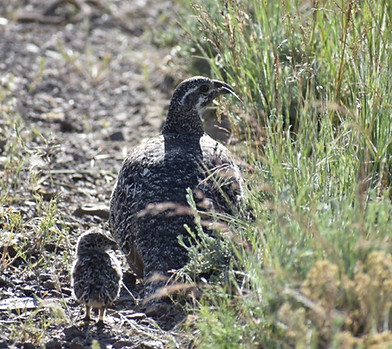

Project Period: 2021-2024
In southern Idaho, the U.S. Air Force conducts aviation military training and combat simulations. These combat simulations involve jet planes flying at low altitude and high speeds focused around two bombing ranges and a collection of emitter stations in Owyhee County. These installations and flyovers occur through greater sage-grouse habitat. Since 1965, greater sage-grouse have experienced a range-wide population decline and are impacted by other types of noise disturbance and human infrastructure. The military has restricted use of some emitters to minimize impacts on sage-grouse attending leks, but we lack information on the effectiveness of these restrictions, or the impacts of intermittent noise on greater sage-grouse. In addition, low-altitude flyovers occur outside of these restrictions, and their impacts on sage-grouse lekking and nesting behavior are still unknown. The primary objective of this project is to document the effects of intermittent noise disturbance from low-level military overflight on nest survival, lek attendance, and behavior of greater sage-grouse. We placed audio recorders and cameras at sage-grouse nests and leks to document sound levels, nest survival, lek attendance, and behavioral responses by lekking sage-grouse. From 2022-2023, we attached radio collars to 53 sage-grouse hens and monitored 26 nests, recording 7,200 hours of audio. We monitored 18 leks from 2022-2023 and collected 13,247 hours of audio and 22,413 scan-sampled behavioral observations. Our results will provide insight into the effectiveness of existing restrictions on military flights near sage-grouse leks and the impacts of intermittent anthropogenic noise disturbance on greater sage-grouse.
Seasonal movements, population connectivity, and survival of
light-footed Ridgway’s Rails
Light-footed Ridgway’s rails (Rallus obsoletus levipes) are federally endangered and they inhabit coastal wetlands within a restricted geographic range that spans the U.S.-Mexico border. These rare birds persist in a highly urbanized landscape where an estimated 70% of historic wetlands have been lost. The wetlands that remain are fragmented and threatened by continued habitat degradation. Despite their rarity, very little is known about their survival, habitat selection, and connectivity among occupied marshes. Moreover, captive bred light-footed Ridgway’s rails are released annually as part of species recovery efforts, but the effectiveness of the captive-breeding program to augment the wild population and the post-release survival and movement of captive-bred rails has never been assessed. We attached satellite transmitters to 48 captive-bred and 42 wild-caught rails to compare survival and habitat selection between wild and captive-bred rails. We collected >8,000 rail locations over 3 years and at 3 study sites to use in our analysis. This information can be used to identify management actions and help improve the captive breeding program and increase survival of captive-raised rails in the wild. Our research will improve our understanding of light-footed Ridgway’s rail demography and enhance the efficacy of current recovery efforts.


Project Period: 2020-2024
Nesting success and recruitment of western grebes in Idaho
We compiled data summarizing the status of current and historical grebe populations on 770 breeding lakes across North America. The largest concentrations of adult grebes (>1000) during the breeding season were concentrated in only 5% of the breeding lakes used by grebes and most (73%) of the 770 breeding lakes supported only small numbers of breeding adults (<100). We developed this breeding lake inventory into an interactive website in partnership with the Center for Digital inquiry and Learning (CDIL) at the University of Idaho and that website will launch in early 2024. Cascade Reservoir supports the largest grebe breeding colony in Idaho. At Cascade Reservoir, we used drones to document the cause of early nest abandonment that we had observed in 2020 and 2021. We reconstructed nest histories and estimated nest fate for >3800 nests based on repeated flights and drone imagery. We estimated nest survival and examined the effects of environmental variables on nest fate. Our results indicate that daily peak wind direction, daily peak wind speed, daily precipitation, daily water level, and date influence nest fate. Daily nest survival decreased as the nesting season progressed and was also low on days when precipitation combined with winds blew into the colony. Our interactive website and research on the factors that affect nest survival will help managers implement actions that can potentially increase grebe recruitment in Idaho and elsewhere. Anne Yen defended her thesis in Dec 2023 and is graduating Spring 2024.


Project Period: 2018-2024
Grouse & Grazing: Effects of Cattle Grazing on Greater Sage-grouse

Despite many studies of greater sage-grouse (Centrocercus urophasianus) habitat requirements, we know surprisingly little about the effects of livestock grazing on sage-grouse populations. As a result, various groups make claims about the presumed effects of livestock grazing on sage-grouse, and litigation over this issue is common. We brought together a multi-partner team to develop and implement a 10-year study with replicated experimental grazing treatments to evaluate the effects of grazing on demographic traits and habitat characteristics of sage-grouse. The results will help guide management actions (and inform policy and litigation decisions) throughout southern Idaho and throughout the species’ range. In 2023, we completed our 10th and final year of data collection for the study. Over the course of the project, we attached transmitters to 1,343 sage-grouse hens and located and monitored 1,216 nests of those radio-marked hens. We have also measured vegetation characteristics at those nests and 3,196 random plots within 21 grazing treatment pastures. In addition, we have also collected 12,446 insect pitfall samples, 6,334 insect sweep net samples, and measured grazing intensity within those same 21 treatment pastures.
Project Period: 2014-2024
Effects of Livestock Grazing and Habitat on Predator-Specific Nest Mortality and Spatiotemporal Activity Patterns of Sage-Grouse Nest Predators
Nests of greater sage-grouse (Centrocercus urophasianus) are depredated by a suite of nest predators that vary in functional traits (e.g., hunting mode). Thus, identifying the mechanisms that influence nest failure can be challenging without identifying the explicit predator species responsible for nest depredation events. We developed a molecular method for identifying sage-grouse nest predators using DNA collected from depredated nests and evaluated how cattle grazing and habitat influences predator-specific nest mortality. To validate our molecular method, we deployed artificial nests with trail cameras and compared molecular results to camera footage. We monitored sage-grouse nests at 5 study sites in Idaho within pastures that varied in grazing intensity and collected DNA samples from 114 depredated nests. Lastly, we deployed camera traps across 6 pastures to quantify how the presence of cattle influences the spatiotemporal activity patterns of coyotes (Canis latrans). We detected nest predators via DNA left on eggshells at 67% of the depredated sage-grouse nests. Grazing did not influence the probability of nest predation by either coyotes or corvids. Sagebrush canopy cover was negatively associated with the probability a coyote depredated a nest, the distance to water was positively associated with the probability a corvid depredated a nest, and ambient temperature was negatively associated with the probability that either a coyote or a corvid depredated a nest. Coyote presence within a pasture was positively associated with the presence of cattle, and coyotes did not shift their diel activity patterns in response to cattle. Our study suggests that domestic cattle grazing does not influence predator-specific nest mortality, at least not for corvids or coyotes. Further, our study suggests that coyotes do not partition themselves in space or time to avoid cattle.


Project Period: 2019-2023
Effects of climate, population density, body condition, and competitors on survival and foraging behavior of northern Idaho ground squirrels
The northern Idaho ground squirrel is a federally threatened species endemic to a 1600-km2 area in Idaho. Fewer than 3,000 squirrels persist in a fragmented metapopulation such that the species now occupies 0.5% of its historic range. Hence, it is imperative that we understand the selection pressures influencing foraging habits and survival of these rare squirrels so that managers can recover the species. We captured and marked 1689 northern Idaho ground squirrels from 2013-2021 for survival analyses and attached 92 geolocators to adult northern Idaho ground squirrels from 2017-2020 to document above-ground foraging activity. We then used statistical models to assess the effects of hibernation, endogenous state, density, and weather on above-ground foraging activity and seasonal survival of northern Idaho ground squirrels. Females had higher survival than males and adults had higher survival than juveniles. Daily survival was greater during hibernation than during the active season. Survival was also density-dependent and negatively associated with Columbian ground squirrel density and total winter snowfall. Foraging activity increased throughout the active season, more so for lean squirrels compared to heavy squirrels. Foraging activity was positively associated with conspecific density and negatively associated with extreme (hot and cold) temperatures. These results suggest management actions that improve forage are likely to promote northern Idaho ground squirrel survival and so populations, though only in areas where Columbian ground squirrels don’t exclude threatened species.

Project Period: 2018-2022